


Check the Free demo of our CIS-DF Exam Dumps with 205 Questions
Clear your concepts with CIS-DF Questions Before Attempting Real exam
NEW QUESTION # 105
What is the value of using the CMDB in security operations? (Choose Two)
- A. Identifies the IT infrastructure with a vulnerability
- B. Enables audits and attestations across CIs
- C. Allows the security team to assess and remediate an incident
- D. Auto-resolves a vulnerability
Answer: A,C
Explanation:
The CMDB plays a critical role in security operations by providing trusted, structured insight into the organization's IT landscape. When built according to Data Foundations principles--accurate discovery, governed relationships, and alignment to CSDM--the CMDB becomes an essential enabler for security incident response and vulnerability management.
Option D is correct because the CMDB allows security teams to identify exactly which IT infrastructure components are affected by a vulnerability. By correlating vulnerability scan results with configuration items (CIs), security teams can determine whether an issue exists on a server, application, cloud resource, or network device--and understand where that CI sits within the broader service context. This eliminates blind spots and reduces time spent investigating unknown or unmanaged assets.
Option A is also correct because the CMDB supports assessment and remediation activities during security incidents. Once affected CIs are identified, the CMDB provides ownership, support group, environment, and service relationships. This enables security teams to quickly route remediation tasks to the correct resolver groups, assess business impact, and prioritize response based on service criticality. While the CMDB does not perform remediation itself, it enables informed and coordinated action.
NEW QUESTION # 106
How does a CMDB Administrator use the ServiceNow Platform to ensure the data quality associated with CIs in the CMDB?
- A. Data Quality Business Rule
- B. Data Quality Scheduled Job
- C. CMDB Audit Business Rule
- D. CMDB Workspace
Answer: B
Explanation:
The correct answer is Data Quality Scheduled Job because CMDB data quality checks are not simply visual or manual activities. Scheduled jobs are used to execute recurring evaluations that calculate and refresh quality indicators for CI records. These jobs support CMDB health and data quality by periodically checking records against configured rules, such as stale records, missing required attributes, compliance conditions, or correctness-related metrics. CMDB Workspace is the interface where users can review and act on CMDB information, but it is not itself the mechanism that performs scheduled quality evaluation. Business rules can enforce logic during insert or update actions, but they are not the normal mechanism for recurring CMDB data quality calculation. Therefore, the Data Quality Scheduled Job is the best answer.
=========
NEW QUESTION # 107
A Configuration Management Process Owner is preparing solution options for presentation to the technical governance board for ingesting custom CIs to the CMDB. The solution needs to align with best practice, minimize the cost of future work (technical debt), and ensure compliance with future upgrades.
Which solutions accomplish this? (Choose two.)
- A. Repurposing a base CI class and renaming attributes, as required
- B. Installing or upgrading the CMDB CI Class Models store application to find a suitable existing CI class accommodating any new attributes
- C. Extending an existing CI class table to accommodate the custom CI class attributes
- D. Extending an existing Asset class table to accommodate the custom CI class attributes
Answer: B,C
Explanation:
Data Foundations emphasizes that "ingest" must produce CMDB data that is standardized, supportable, and upgrade-safe. When introducing custom CIs, the best practice is to reuse the most appropriate existing CI class (or an approved industry-aligned model) and only add what is necessary-this keeps the data model aligned with platform expectations and reduces downstream rework.
Option B supports this directly: the CMDB CI Class Models application is intended to help teams select a suitable existing class rather than inventing new classes unnecessarily. Reusing existing classes improves consistency across integrations, Discovery/Service Mapping patterns, reporting, and CMDB Health rules- reducing technical debt and making future platform upgrades smoother.
Option A is also aligned with best practice when used correctly: once you have the right CI class, extending that class to add additional attributes (new fields) is a standard, upgrade-safe customization approach. It preserves the underlying platform data structures and avoids breaking out-of-box behaviors, identification
/reconciliation practices, and CMDB Health evaluations.
Option C is not appropriate because Asset tables serve a different purpose (financial/lifecycle tracking) than CI tables (operational/service context). Mixing CI attributes into Asset classes creates confusion and process misalignment. Option D is strongly discouraged because repurposing and renaming base attributes creates long-term ambiguity, breaks shared semantics, and increases upgrade and maintenance risk.
NEW QUESTION # 108
A ServiceNow Process Owner wants to use Business Application records to drive business decisions.
How can the Process Owner use these records?
- A. Monitor application availability.
- B. Perform application rationalization.
- C. Determine applications impacted by a Change Request.
Answer: B
Explanation:
Business Application records represent logical applications from a portfolio, ownership, investment, risk, and lifecycle perspective. They are principally used by Application Portfolio Management and Enterprise Architecture to support application rationalization .
Rationalization enables an organization to evaluate applications based on factors such as business value, technical fitness, cost, risk, lifecycle status, capability alignment, and functional redundancy. Decision-makers can then determine whether an application should be invested in, tolerated, migrated, consolidated, replaced, or retired.
Application availability is normally monitored through operational Application Services and their supporting infrastructure rather than through the logical Business Application record. Change impact analysis also relies mainly on Application Services, service maps, and relationships to affected infrastructure CIs.
Because Business Applications belong to the Design and Planning context and provide strategic portfolio information, application rationalization is the appropriate business-decision use case Bottom of Form
NEW QUESTION # 109
A CMDB Administrator needs to set up CMDB 360/Multisource CMDB Drag and drop the system propertyto the functionality Some options may not apply.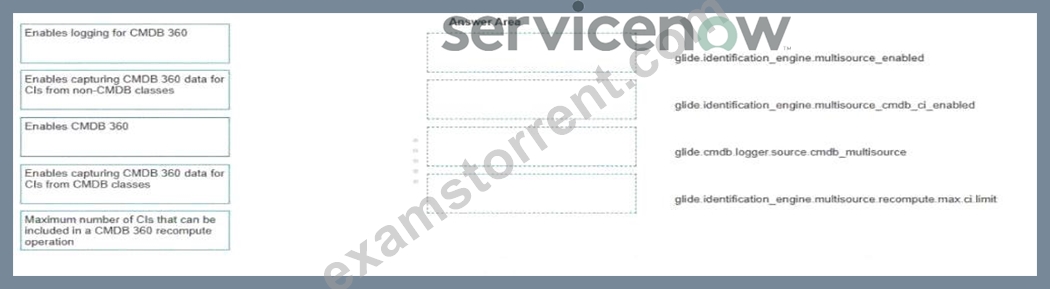
Answer:
Explanation: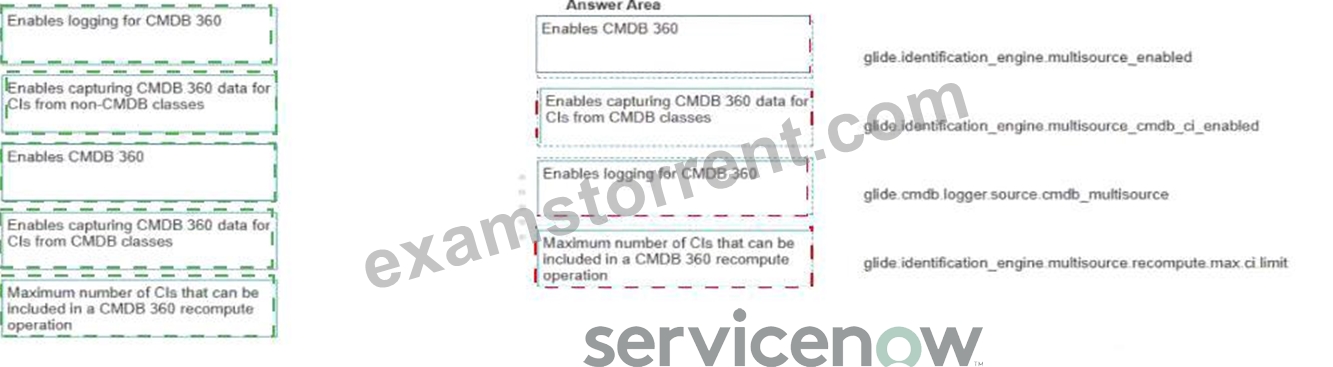
Explanation: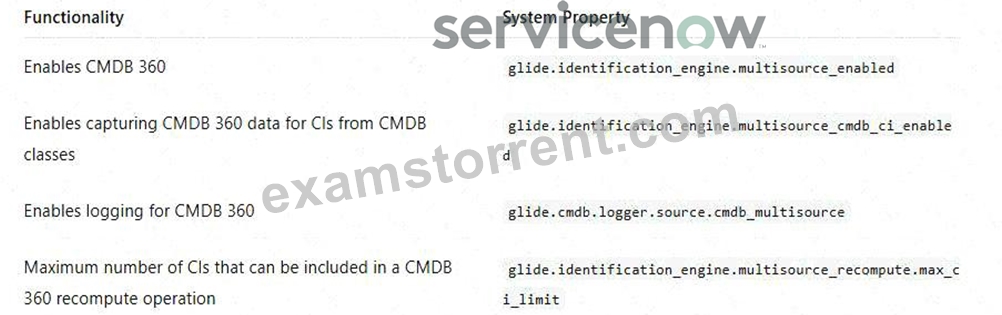
InServiceNow,CMDB 360 / Multisource CMDBextends the Identification and Reconciliation Engine (IRE) to supportmulti-source visibility, reconciliation, and confidence scoring. Configuration is controlled throughsystem properties, each enabling a specific capability.
glide.identification_engine.multisource_enabledis the master switch that activates CMDB 360 functionality.
glide.identification_engine.multisource_cmdb_ci_enabledallows CMDB 360 to collect and evaluate data specifically fromCMDB CI classes.
glide.cmdb.logger.source.cmdb_multisourceenables detailed logging for troubleshooting multisource ingestion and reconciliation.
glide.identification_engine.multisource_recompute.max_ci_limitprotects performance by limiting how many CIs can be processed during a recompute operation.
Capturing CMDB 360 data fromnon-CMDB classesisnot supported, which is why no property applies to that option.
This mapping aligns withData Foundations and CMDB governance best practices, ensuring CMDB 360 is enabled safely, transparently, and at scale.
NEW QUESTION # 110
A CMDB Data Owner has requested better insights into the different data sources that make up the CMDB data set. The Platform Owner knows that the new Service Graph Connector Central plugin is what is needed.
After installing the plugin, what workspace will have the new Service Graph Connector Central tab available?
- A. Discovery Admin Workspace
- B. Service Graph Connector Workspace
- C. CMDB Workspace
Answer: C
Explanation:
The correct answer is CMDB Workspace. Service Graph Connector Central is designed to improve visibility into Service Graph Connector activity and source contribution within the CMDB operating experience. Since the objective is to understand data sources contributing to the CMDB, the functionality is surfaced in CMDB Workspace rather than a separate Service Graph Connector Workspace or Discovery Admin Workspace.
CMDB Workspace is the central workspace for managing CMDB data quality, source visibility, health, governance, and operational CMDB activities. Discovery Admin Workspace is focused on Discovery configuration and operations, not central CMDB source insight. Therefore, once the Service Graph Connector Central plugin is installed, the related tab is available in CMDB Workspace.
=========
NEW QUESTION # 111
Which is a purpose or requirement ofCMDB Data Managerin ServiceNow?
- A. Encrypts archived records for enhanced security
- B. Automates the enforcement of relationship rules between CIs in the CMDB
- C. Automates the archival and deletion of records based on retention policies
Answer: C
Explanation:
TheCMDB Data Managercapability inServiceNowis designed to supportCMDB governance, specifically arounddata lifecycle management. Its primary purpose is to ensure that CI records areretained, archived, and deletedin accordance with definedretention policies, regulatory requirements, and organizational data governance standards.
As CMDBs mature, they naturally accumulate obsolete, retired, or decommissioned CIs. If these records are not properly managed, they negatively impact CMDB health, reporting accuracy, discovery reconciliation, and performance. CMDB Data Manager addresses this byautomating the archival and deletion of recordsonce lifecycle conditions and retention thresholds are met.
Option A is incorrect because encryption of archived records is handled by platform-level security and data protection features, not CMDB Data Manager. Option B is also incorrect becauserelationship rule enforcementis managed through CSDM guidance, CMDB relationship rules, and identification/reconciliation logic-not by CMDB Data Manager.
By automating retention-based archival and cleanup, CMDB Data Manager helps organizations maintain alean, compliant, and high-quality CMDB, which directly supports CMDB Health metrics such as correctness and compliance.
Therefore, the correct and verified answer isOption C.
NEW QUESTION # 112
A CMDB Administrator has built a number of Technology Management Service Offerings (Technical Service Offerings) based on Dynamic CI Groups to better maintain group alignment for the member CIs.
Which groups are synced to CIs from the offering that has a relationship to a Dynamic CI Group?
(Choose 2 options)
- A. Managed by Group
- B. Owned by Group
- C. Support Group
- D. Approval Group
Answer: A,C
Explanation:
In ServiceNow, Dynamic CI Groups are a core Data Foundations capability used to automatically manage CI membership based on rules rather than manual maintenance. When Technology Management Service Offerings (Technical Service Offerings) are related to Dynamic CI Groups, ServiceNow uses those relationships to synchronize operational support attributes to the member CIs.
The two CI attributes that are intentionally designed to sync in this model are the Managed by Group and the Support Group. These groups directly influence operational ownership and support routing, which is why they are automatically aligned when Dynamic CI Groups are used.
This ensures that incidents, changes, problems, and operational tasks are routed consistently as CI membership changes over time.
The Support Group defines who provides day-to-day operational support and is critical for Incident and Request Management workflows. The Managed by Group represents the team responsible for the technical lifecycle and operational health of the CI. Synchronizing these attributes eliminates manual updates and reduces misrouted tickets, which is a key goal of Configuration Management maturity.
NEW QUESTION # 113
Given a list of Service types in the platform, drag the appropriate service to its definition.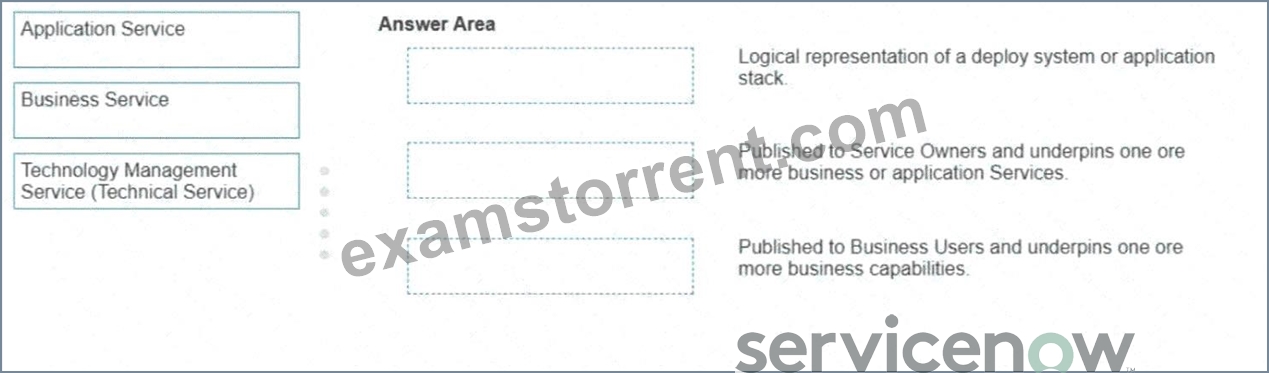
Answer:
Explanation: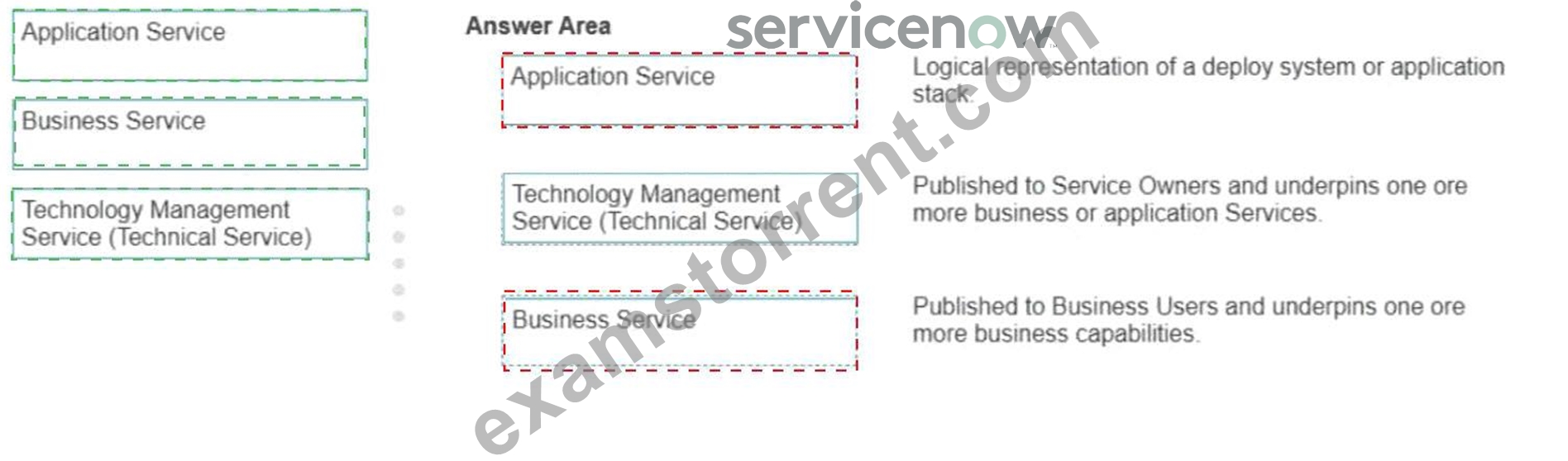
Explanation: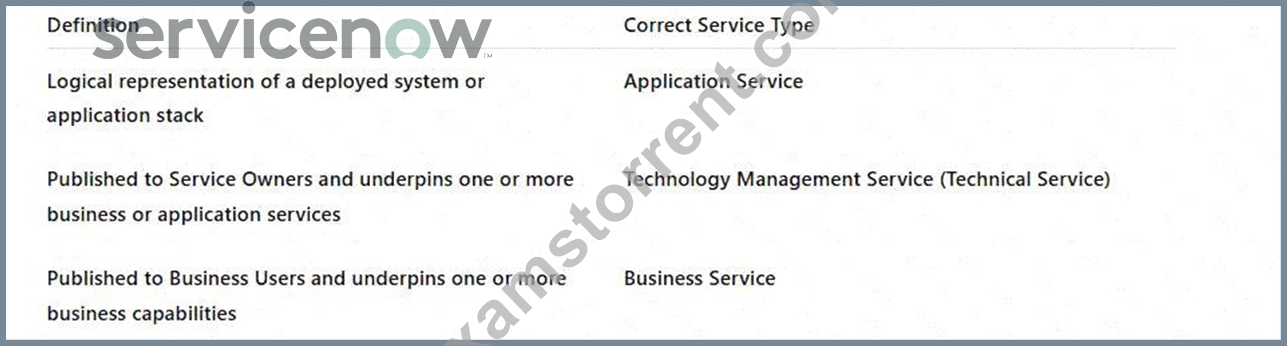
Within the Common Service Data Model (CSDM), service types are clearly defined to separate business- facing value, application logic, and technical enablement. Correct classification is foundational to impact analysis, ownership, reporting, and service visibility.
An Application Service is a logical representation of a deployed application or system stack. It models how an application runs, including servers, databases, middleware, and integrations. Application Services are typically created and maintained through Service Mapping and are primarily consumed by IT operations, DevOps, and support teams.
A Technology Management Service (also called a Technical Service) represents shared technical capabilities such as databases, authentication platforms, messaging systems, or cloud infrastructure. These services are published to Service Owners, not business users, and underpin one or more Application Services or Business Services. They are critical for understanding technical dependencies and risk but are not business-facing.
A Business Service is published to Business Users and directly supports business capabilities and outcomes. It represents what the business consumes , such as "Online Banking," "Order Fulfillment," or "Employee Onboarding." Business Services sit at the top of the CSDM hierarchy and are the anchor point for SLAs, experience, and value measurement.
Correctly distinguishing these service types ensures alignment with CSDM best practices, enables accurate impact analysis, and prevents common CMDB anti-patterns such as exposing technical services to business users or misrepresenting application stacks as business value.
NEW QUESTION # 114
The CMDB Administrator has set up two Dynamic Reconciliation Rules within the ServiceNow Production Instance. The 'Server' class has a Dynamic Reconciliation Rule of largest value for the RAM field. The 'Windows Server' class has a Dynamic Reconciliation Rule of most reported for the RAM field.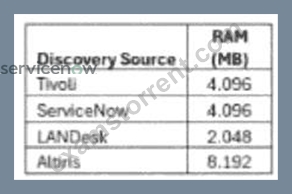
Given the above data inMultisource CMDB, which value is added to the CMDB forRAMfor aServer CI?
- A. 2,048 MB
- B. 4,096 MB
- C. 8,192 MB
Answer: C
Explanation:
This question hinges on understandingclass-specific Dynamic Reconciliation RulesinCMDB 360 / Multisource CMDBwithinServiceNow.
Although two different dynamic rules are configured,the rule applied depends on the CI class being evaluated:
For theServerclass, the configured rule isLargest valuefor the RAM attribute.
For theWindows Serverclass, the ruleMost reportedwould apply-butonly if the CI were evaluated as a Windows Server.
The question explicitly asks for the resulting RAM value for aServer CI, not a Windows Server CI. Therefore, theLargest valuerule governs the outcome.
Looking at the multisource values:
2,048 MB (LANDesk)
4,096 MB (Tivoli)
4,096 MB (ServiceNow)
8,192 MB (Altiris)
Under theLargest valuedynamic reconciliation rule, the IRE selects themaximum numeric value, regardless of how frequently it is reported or which source provided it.
TheMost reportedlogic (which would result in 4,096 MB) doesnot applyhere because that rule is configured for a different class (Windows Server).
This scenario illustrates an important CMDB 360 principle:Dynamic reconciliation is evaluated per class, and child-class rules do not override parent-class rules unless the CI is actually classified under that child class.
NEW QUESTION # 115
A Data Center Manager is working with the CMDB CI Class Manager to define the relationship between Application Servers and the Applications they host. The company has multiple Application Servers that host one or more Applications.
Which describes the relationship between the Application Server table and the Application table?
- A. One-to-many
- B. Many-to-one
- C. One-to-one
- D. Many-to-many
Answer: D
Explanation:
In CMDB modeling, accurately defining relationships is critical for impact analysis, service mapping, and Change Management. In this scenario, Application Servers can host multiple Applications, and Applications can also run across multiple Application Servers (for example, in clustered, load- balanced, or distributed architectures).
This architectural reality defines a many-to-many relationship between the Application Server table and the Application table.
In ServiceNow, many-to-many relationships are common for application hosting models, especially in modern environments that use horizontal scaling, redundancy, or containerized workloads. Modeling this correctly ensures that incidents, changes, and outages affecting a single server can be accurately traced to all impacted applications--and vice versa.
A one-to-many or many-to-one relationship would incorrectly assume exclusivity in one direction, which does not reflect real-world application deployment patterns. A one-to-one relationship would be even more restrictive and inaccurate.
NEW QUESTION # 116
During implementation, architects want to create a new CI class outside the cmdb_ci hierarchy.
What is the correct approach?
- A. Create a new unrelated table
- B. Create a custom asset table
- C. Extend cmdb_ci
- D. Modify task table
Answer: C
Explanation:
All CI classes must extend from cmdb_ci to maintain CMDB integrity and IRE functionality.
NEW QUESTION # 117
Drag the ServiceNow product to the outcomes by utilizing the CMDB.
Instructions: Two drag handles (shown as a series of dots) allow you to resize the columns to better view the text.
To move an item, click and hold the text in the left column, then drag and drop it into the appropriate box in the right column.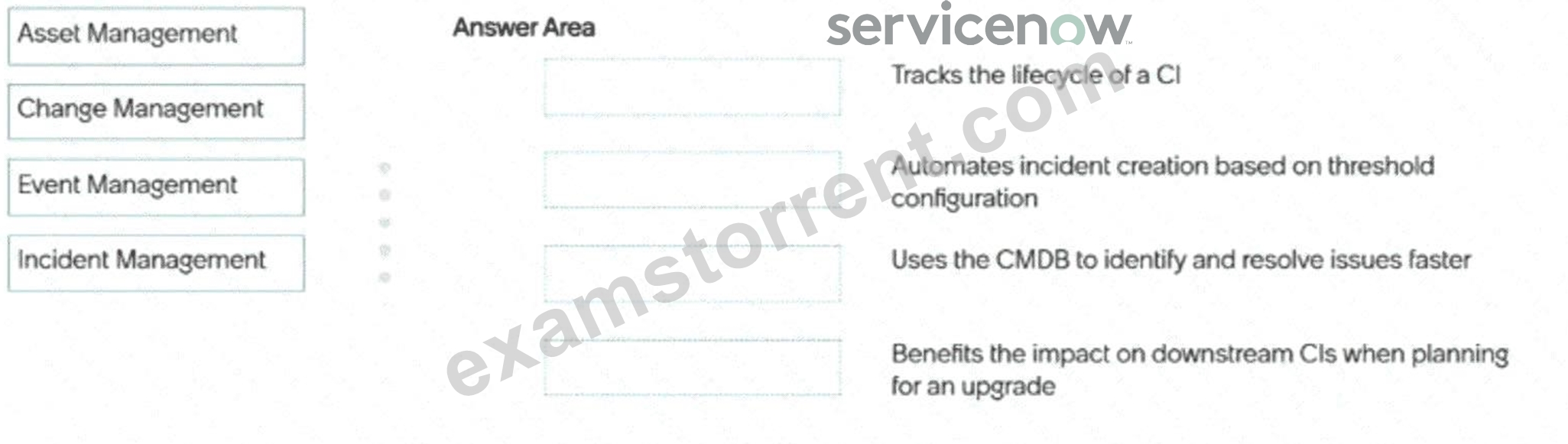
Answer:
Explanation: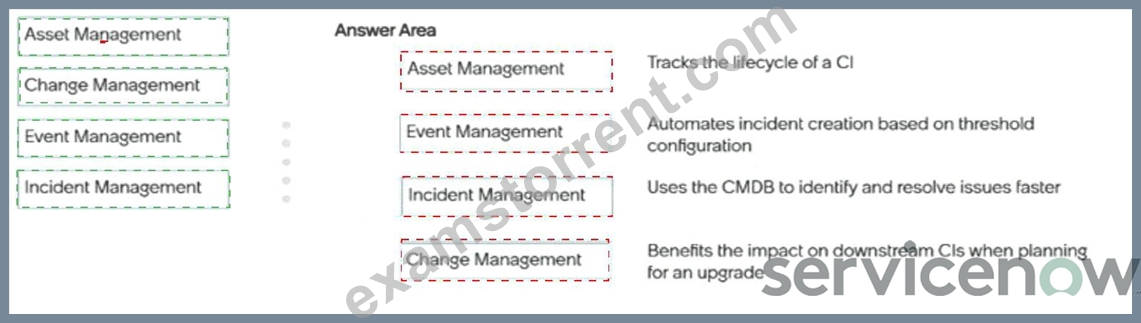
Explanation:
Asset Management # Tracks the lifecycle of a CI
Asset Management uses CMDB and asset data to track an item throughout its lifecycle, including procurement, deployment, operation, maintenance, retirement, and disposal. This helps the organization understand both the operational status of the CI and its financial or contractual information.
Event Management # Automates incident creation based on threshold configuration Event Management collects events from monitoring tools and evaluates them against configured rules and thresholds. When a threshold is exceeded or a significant alert is generated, ServiceNow can automatically create an incident and associate it with the affected CI in the CMDB.
Incident Management # Uses the CMDB to identify and resolve issues faster Incident Management uses CI records and relationships to determine which component is affected, who supports it, and which services depend on it. This provides technicians with accurate context, enabling faster assignment, troubleshooting, impact assessment, and resolution.
Change Management # Identifies the impact on downstream CIs when planning for an upgrade Change Management uses CMDB relationships to evaluate the potential impact of a planned change. Before upgrading a server, application, or other CI, the change team can identify dependent and downstream CIs or services that could be affected, reducing the risk of outages or unexpected disruption.
NEW QUESTION # 118
(Choose two)
A CMDB Administrator is leveraging CI data as part of anIntegrated Risk Management (IRM)implementation and theEntity Scopingprocess. The Administrator wants to leverage theCSDM Data Foundations Dashboard playbooks under the Run tab.
WhichCSDM relationshipsare leveraged using the CSDM playbooks?
- A. Business Applications that have their relationships to Information Objects
- B. Logical CIs that have relationships with Information Objects
- C. Locations that have established parent records
- D. Business Applications that have relationships to Application Services
Answer: A,B
Explanation:
TheRuntab in theCSDM Data Foundations Dashboardfocuses on enablingoperationalized, risk-aware use cases, includingIntegrated Risk Management (IRM)andEntity Scoping. These use cases require organizations to understandwhat data is processed,where it resides, andwhich technical components are involved, rather than only service impact for ITSM.
Information Objectsplay a central role at this stage.
Option Ais correct becauseBusiness Applications related to Information Objectsallow organizations to identifywhat types of data (PII, PCI, PHI, regulated data)are processed by each business application. This relationship is essential forrisk classification, regulatory compliance, and audit scopingin IRM. Without it, risk assessments lack data sensitivity context.
Option Dis also correct becauseLogical CIs (such as databases, schemas, or data stores) related to Information Objectsestablishwhere sensitive data is stored or processedat a technical level. This enables IRM to trace risk from business context down to technical exposure, supporting control testing, issue management, and remediation prioritization.
Option B (Location hierarchy) supports foundational data quality but does not directly enable risk or entity scoping. Option C (Business Applications to Application Services) is critical forservice impact and Change
/Incident Management, but it is more aligned toservice operationsrather thanrisk and data-centric scoping, which is the focus of the Run playbooks for IRM.
Therefore, the correct answers areA and D, as they directly supportIRM entity scoping, regulatory analysis, and risk visibilitythrough CSDM-aligned data modeling.
NEW QUESTION # 119
A CMDB Administrator is leveraging CI data as part of an Integrated Risk Management (IRM) implementation and the Entity Scoping process. The Administrator wants to leverage the CSDM Data Foundations Dashboard playbooks under the Run tab.
Which CSDM relationships are leveraged using the CSDM playbooks? (Choose two)
- A. Business Applications that have their relationships to Information Objects
- B. Logical CIs that have relationships with Information Objects
- C. Locations that have established parent records
- D. Business Applications that have relationships to Application Services
Answer: A,B
Explanation:
The Run tab in the CSDM Data Foundations Dashboard focuses on enabling operationalized, risk- aware use cases, including Integrated Risk Management (IRM) and Entity Scoping. These use cases require organizations to understand what data is processed, where it resides, and which technical components are involved, rather than only service impact for ITSM.
Information Objects play a central role at this stage.
Option A is correct because Business Applications related to Information Objects allow organizations to identify what types of data (PII, PCI, PHI, regulated data) are processed by each business application. This relationship is essential for risk classification, regulatory compliance, and audit scoping in IRM. Without it, risk assessments lack data sensitivity context.
Option D is also correct because Logical CIs (such as databases, schemas, or data stores) related to Information Objects establish where sensitive data is stored or processed at a technical level. This enables IRM to trace risk from business context down to technical exposure, supporting control testing, issue management, and remediation prioritization.
NEW QUESTION # 120
What ensures data volume in the CMDB is manageable?
- A. Scheduled Jobs
- B. Business Rules
- C. Archive Policies
Answer: C
Explanation:
Managing CMDB data volume is a key Data Foundations governance objective. Over time, CMDBs naturally accumulate retired, obsolete, or decommissioned CIs. If these records are not properly managed, they degrade CMDB performance, reduce reporting accuracy, and negatively impact discovery reconciliation and health scores.
Archive Policies are the mechanism designed to address this challenge. They define when CI records should be archived or deleted based on lifecycle state, age, or retention requirements. By automating archival and cleanup, archive policies ensure that only relevant, active CIs remain in the operational CMDB, keeping data volume manageable and performant.
NEW QUESTION # 121
A healthcare provider faces a critical incident affecting its patient management system. The provider needs to identify the users impacted to mitigate disruption effectively.
Which CSDM-related data should they leverage?
- A. Incident history of similar CIs
- B. Service Offerings by Department or Location
- C. Affected CI [task_ci] related list
- D. Service environment attribute
Answer: B
Explanation:
In a healthcare environment, identifying who is impacted during a critical incident is essential to patient safety and continuity of care. Within the Common Service Data Model (CSDM), the most effective way to determine impacted users is through Service Offerings, particularly when they are defined by department or location.
Service Offerings represent how a service is consumed by specific user groups. In this case, a patient management system may have different offerings for departments such as Emergency, Inpatient Care, or Outpatient Services, or be scoped by hospital location. These offerings explicitly define consumer context, allowing incident responders to immediately identify which clinicians, staff, or facilities are affected.
NEW QUESTION # 122
A Configuration Manager notices that the CMDB Health Dashboard Completeness Key Performance Indicator is low.
What can the Configuration Manager do to obtain a KPI that represents only CIs that are managed?
- A. Nothing; the health score is calculated for the entire CMDB.
- B. Create a business rule to filter the CMDB Health results.
- C. Configure Health Inclusion Rules for the relevant CI classes.
Answer: C
Explanation:
Health Inclusion Rules determine which CI records are included in CMDB Health calculations. Health Inclusion Rules The Configuration Manager can configure conditions for the relevant CI classes so that only managed, operationally relevant, or management-ready CIs contribute to the Completeness KPI.
For example, an inclusion rule can limit the calculation based on lifecycle stage, operational status, environment, discovery source, or another class attribute that identifies managed CIs. This prevents unmanaged, retired, transitional, or incomplete populations that are not yet under governance from distorting the organization's health score.
A custom business rule is unnecessary and would introduce avoidable customization and maintenance effort.
The score also does not have to include the entire CMDB because each health metric can have a separately controlled evaluation scope. Therefore, configuring Health Inclusion Rules i
NEW QUESTION # 123
......
Get professional help from our CIS-DF Dumps PDF: https://troytec.examstorrent.com/CIS-DF-exam-dumps-torrent.html