


Professional-Cloud-Security-Engineer Dumps (2026) Prepare Your Exam With 320 Questions
New Professional-Cloud-Security-Engineer Dumps - Real Google Exam Questions
What is Google Professional Cloud Security Engineer Exam
The Google Professional Cloud Security Engineer is a private administrator responsible for helping organizations define and enforce a highly secure infrastructure on the Google Cloud Platform (GCP). GCP's professional cloud security Engineer uses an in-depth understanding of security and safety best practices, as well as an in-depth understanding of market security needs.
The cloud security designer brings his knowledge to the design, advancement, and management of the framework through Google security innovations. The GCP Cloud Security Engineer Certification Exam helps validate an individual's proficiency in various skills. Skills and areas of understanding include identifying and tracking access, as well as using Google security technologies to ensure data protection.
The certification exam will no doubt also assess candidates' abilities to configure network security measures and collect and evaluate Google Cloud logs. In addition, the role of a cloud security designer also includes event response management and a broader understanding of regulatory policies.
Google Professional-Cloud-Security-Engineer certification exam is designed for individuals who are interested in validating their skills and knowledge in the field of cloud security. Google Cloud Certified - Professional Cloud Security Engineer Exam certification exam is one of the most sought-after certifications in the industry, and is offered by Google Cloud Platform (GCP). Professional-Cloud-Security-Engineer exam is designed to test the skills and knowledge of individuals in cloud security, risk management, compliance, and security operations.
NEW QUESTION # 81
Your organization is using Vertex AI Workbench Instances. You must ensure that newly deployed instances are automatically kept up-to-date and that users cannot accidentally alter settings in the operating system. What should you do?
- A. Enable the VM Manager and ensure the corresponding Google Compute Engine instances are added.
- B. Enforce the disableRootAccess and requireAutoUpgradeSchedule organization policies for newly deployed instances.
- C. Implement a firewall rule that prevents Secure Shell access to the corresponding Google Compute Engine instances by using tags.
- D. Assign the AI Notebooks Runner and AI Notebooks Viewer roles to the users of the AI Workbench Instances.
Answer: B
Explanation:
To ensure that Vertex AI Workbench Instances are automatically kept up-to-date and that users cannot alter operating system settings, implementing specific organization policies is essential.
Option A: Enabling VM Manager and adding Compute Engine instances assists in managing and monitoring VM instances but does not enforce automatic updates or restrict user modifications to the operating system.
Option B: Enforcing the disableRootAccess organization policy prevents users from gaining root access, thereby restricting unauthorized changes to the operating system. Additionally, the requireAutoUpgradeSchedule policy ensures that instances are automatically updated according to a defined schedule. Together, these policies maintain system integrity and compliance with update requirements.
Option C: Assigning AI Notebooks Runner and AI Notebooks Viewer roles controls user permissions related to running and viewing notebooks but does not directly influence operating system settings or update mechanisms.
Option D: Implementing firewall rules to prevent SSH access limits direct access to instances but does not ensure automatic updates or prevent alterations through other means.
Therefore, Option B is the most appropriate action, as it directly addresses both the enforcement of automatic updates and the prevention of unauthorized operating system modifications.
Reference:
Organization Policy Constraints
VM Manager Overview
NEW QUESTION # 82
Your organization must comply with the regulation to keep instance logging data within Europe. Your workloads will be hosted in the Netherlands in region europe-west4 in a new project. You must configure Cloud Logging to keep your data in the country.
What should you do?
- A. Create a new tog bucket in europe-west4. and redirect the _Def auit bucKet to the new bucket.
- B. Configure the organization policy constraint gcp.resourceLocations to europe-west4.
- C. Set the logging storage region to eurcpe-west4 by using the gcloud CLI logging settings update.
- D. Configure log sink to export all logs into a Cloud Storage bucket in europe-west4.
Answer: A
NEW QUESTION # 83
A company allows every employee to use Google Cloud Platform. Each department has a Google Group, with all department members as group members. If a department member creates a new project, all members of that department should automatically have read-only access to all new project resources. Members of any other department should not have access to the project. You need to configure this behavior.
What should you do to meet these requirements?
- A. Create a Folder per department under the Organization. For each department's Folder, assign the Project Viewer role to the Google Group related to that department.
- B. Create a Folder per department under the Organization. For each department's Folder, assign the Project Browser role to the Google Group related to that department.
- C. Create a Project per department under the Organization. For each department's Project, assign the Project Browser role to the Google Group related to that department.
- D. Create a Project per department under the Organization. For each department's Project, assign the Project Viewer role to the Google Group related to that department.
Answer: A
Explanation:
Explanation
https://cloud.google.com/iam/docs/understanding-roles#project-roles
NEW QUESTION # 84
A customer implements Cloud Identity-Aware Proxy for their ERP system hosted on Compute Engine. Their security team wants to add a security layer so that the ERP systems only accept traffic from Cloud Identity- Aware Proxy.
What should the customer do to meet these requirements?
- A. Make sure that the ERP system can validate the identity headers in the HTTP requests.
- B. Make sure that the ERP system can validate the x-forwarded-for headers in the HTTP requests.
- C. Make sure that the ERP system can validate the user's unique identifier headers in the HTTP requests.
- D. Make sure that the ERP system can validate the JWT assertion in the HTTP requests.
Answer: D
Explanation:
Explanation/Reference:
NEW QUESTION # 85
You have the following resource hierarchy. There is an organization policy at each node in the hierarchy as shown. Which load balancer types are denied in VPC A?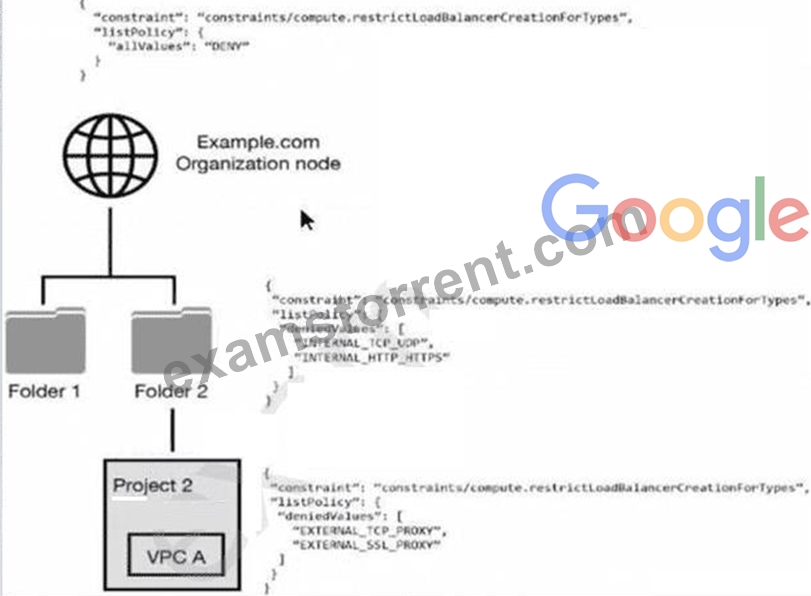
- A. EXTERNAL_TCP_PROXY, EXTERNAL_SSL_PROXY are denied in accordance with the project's policy.
- B. INTERNAL_TCP_UDP, INTERNAL_HTTP_HTTPS is denied in accordance with the folder's policy.
- C. All load balancer types are denied in accordance with the global node's policy.
- D. EXTERNAL_TCP_PROXY, EXTERNAL_SSL_PROXY, INTERNAL_TCP_UDP, andINTERNAL_HTTP_HTTPS are denied in accordance with the folder and project's policies.
Answer: D
Explanation:
Understanding Organization Policies:
Organization policies are rules that can be set at different levels of the resource hierarchy in GCP to enforce governance and compliance.
These policies can be set at the organization node, folders, and projects, and they are inherited down the hierarchy unless explicitly overridden.
Hierarchy and Policy Inheritance:
The provided resource hierarchy has an organization node (Example.com), folders (Folder 1 and Folder 2), and a project (Project 2) under Folder 2 with a specific VPC (VPC A).
Each node in the hierarchy can have its own policies, and these policies are inherited by child nodes unless overridden.
Analyzing the Policies in the Hierarchy:
Organization Node Policy:
json
Copy code
{ "constraint": "constraints/compute.restrictLoadBalancerCreationForTypes", "listPolicy": { "allValues":
"DENY" } }
This policy at the organization node denies all load balancer types.
Folder 2 Policy:
json
Copy code
{ "constraint": "constraints/compute.restrictLoadBalancerCreationForTypes", "listPolicy": { "deniedValues":
["INTERNAL_TCP_UDP", "INTERNAL_HTTP_HTTPS"] } }
This policy at Folder 2 denies the creation of INTERNAL_TCP_UDP and INTERNAL_HTTP_HTTPS load balancers.
Project 2 Policy:
json
Copy code
{ "constraint": "constraints/compute.restrictLoadBalancerCreationForTypes", "listPolicy": { "deniedValues":
["EXTERNAL_TCP_PROXY", "EXTERNAL_SSL_PROXY"] } }
This policy at Project 2 denies the creation of EXTERNAL_TCP_PROXY and EXTERNAL_SSL_PROXY load balancers.
Policy Application to VPC A:
Since policies are inherited, VPC A (which is within Project 2 under Folder 2) will be affected by the policies of both Folder 2 and Project 2.
Combining the denied values from both Folder 2 and Project 2:
From Folder 2: INTERNAL_TCP_UDP, INTERNAL_HTTP_HTTPS
From Project 2: EXTERNAL_TCP_PROXY, EXTERNAL_SSL_PROXY
Conclusion:
VPC A will have the following load balancer types denied: INTERNAL_TCP_UDP, INTERNAL_HTTP_HTTPS, EXTERNAL_TCP_PROXY, EXTERNAL_SSL_PROXY.
References:
GCP Documentation on Organization Policies
GCP Documentation on Constraints and List Policies
NEW QUESTION # 86
Your company has been creating users manually in Cloud Identity to provide access to Google Cloud resources. Due to continued growth of the environment, you want to authorize the Google Cloud Directory Sync (GCDS) instance and integrate it with your on-premises LDAP server to onboard hundreds of users. You are required to:
Replicate user and group lifecycle changes from the on-premises LDAP server in Cloud Identity.
Disable any manually created users in Cloud Identity.
You have already configured the LDAP search attributes to include the users and security groups in scope for Google Cloud. What should you do next to complete this solution?
- A. 1. Configure the LDAP search attributes to exclude manually created Cloud identity users not found in LDAP.
2. Run GCDS after user and group lifecycle changes. - B. 1. Configure the option to delete domain users not found in LDAP.
2. Run GCDS after user and group lifecycle changes. - C. 1. Configure the LDAP search attributes to exclude manually created Cloud Identity users not found in LDAP.
2. Set up a recurring GCDS task. - D. 1. Configure the option to suspend domain users not found in LDAP.
2. Set up a recurring GCDS task.
Answer: D
Explanation:
Explanation
To achieve the requirement "Disable any manually created users in Cloud Identity", configure GCDS to suspend rather than delete accounts if user accounts are not found in the LDAP directory in GCDS.
Ref:https://support.google.com/a/answer/7177267
NEW QUESTION # 87
A company is running workloads in a dedicated server room. They must only be accessed from within the private company network. You need to connect to these workloads from Compute Engine instances within a Google Cloud Platform project.
Which two approaches can you take to meet the requirements? (Choose two.)
- A. Configure the project with Cloud Interconnect.
- B. Configure the project with Cloud VPN.
- C. Configure the project with VPC peering.
- D. Configure all Compute Engine instances with Private Access.
- E. Configure the project with Shared VPC.
Answer: A,B
Explanation:
A) IPsec VPN tunels: https://cloud.google.com/network-connectivity/docs/vpn/concepts/overview Interconnect https://cloud.google.com/network-connectivity/docs/interconnect/concepts/dedicated-overview
NEW QUESTION # 88
As adoption of the Cloud Data Loss Prevention (DLP) API grows within the company, you need to optimize usage to reduce cost. DLP target data is stored in Cloud Storage and BigQuery. The location and region are identified as a suffix in the resource name.
Which cost reduction options should you recommend?
- A. Set appropriate rowsLimit value on BigQuery data hosted outside the US and set appropriate bytesLimitPerFile value on multiregional Cloud Storage buckets.
- B. Set appropriate rowsLimit value on BigQuery data hosted outside the US, and minimize transformation units on multiregional Cloud Storage buckets.
- C. Use FindingLimits and TimespanContfig to sample data and minimize transformation units.
- D. Use rowsLimit and bytesLimitPerFile to sample data and use CloudStorageRegexFileSet to limit scans.
Answer: D
Explanation:
https://cloud.google.com/dlp/docs/inspecting-storage#sampling https://cloud.google.com/dlp/docs/best-practices-costs#limit_scans_of_files_in_to_only_relevant_files
NEW QUESTION # 89
You work for a financial organization in a highly regulated industry that is subject to active regulatory compliance. To meet compliance requirements, you need to continuously maintain a specific set of configurations, data residency, organizational policies, and personnel data access controls. What should you do?
- A. Create an Assured Workloads folder for your required compliance program to apply defined controls and requirements.
- B. Apply an organizational policy constraint at the organization level to limit the location of new resource creation.
- C. Go to the Compliance page in Security Command Center View the report for your status against the required compliance standard. Triage violations to maintain compliance on a regular basis.
- D. Create a posture.yaml file with the required security compliance posture. Apply the posture with the gcloud sec postures create POSTURE_NAME --posture-from-file=posture.yaml command in Security Command Center Premium.
Answer: A
Explanation:
Comprehensive and Detailed Explanation From Exact Extract:
The key requirements are maintaining a specific set of controls, including data residency and personnel data access controls, specifically to meet a highly regulated industry's compliance program.
Assured Workloads is the specific Google Cloud service designed to help customers meet these stringent regulatory and compliance requirements (e.g., FINRA, FedRAMP, HIPAA, etc.) by enforcing a specific control bundle.
Extracts:
"Assured Workloads helps organizations run their sensitive workloads securely and in a compliant manner...
by providing continuous compliance monitoring for specific compliance programs." (Source 4.1)
"When you create an Assured Workloads folder, the platform automatically enforces compliance controls...
including: Data residency and location controls... Personnel access controls... Organizational policies..." (Source 4.2) This service creates a dedicated, compliant environment in a folder, ensuring the necessary configurations and personnel controls are applied automatically and continuously maintained, which is a more complete solution than the posture management in option B (which focuses only on configuration monitoring) or the singular organizational policy in option C.
NEW QUESTION # 90
You need to connect your organization's on-premises network with an existing Google Cloud environment that includes one Shared VPC with two subnets named Production and Non-Production. You are required to:
Use a private transport link.
Configure access to Google Cloud APIs through private API endpoints originating from on-premises environments.
Ensure that Google Cloud APIs are only consumed via VPC Service Controls.
What should you do?
- A. 1. Set up a Dedicated Interconnect link between the on-premises environment and Google Cloud.
2. Configure private access using the restricted.googleapis.com domains in on-premises DNS configurations. - B. 1. Set up a Partner Interconnect link between the on-premises environment and Google Cloud.
2. Configure private access using the private.googleapis.com domains in on-premises DNS configurations. - C. 1. Set up a Cloud VPN link between the on-premises environment and Google Cloud.
2. Configure private access using the restricted googleapis.com domains in on-premises DNS configurations. - D. 1. Set up a Direct Peering link between the on-premises environment and Google Cloud.
2. Configure private access for both VPC subnets.
Answer: A
Explanation:
Set up a Dedicated Interconnect link between the on-premises environment and Google Cloud:
Dedicated Interconnect provides a direct physical connection between your on-premises network and Google's network, which is ideal for high-throughput, low-latency connections.
Request a Dedicated Interconnect from the Google Cloud Console, specifying the required bandwidth and location.
Once provisioned, set up the connection on your on-premises router and configure the BGP sessions to exchange routes with Google Cloud.
Configure private access using the restricted.googleapis.com domains in on-premises DNS configurations:
Configure your on-premises DNS server to resolve Google APIs to restricted.googleapis.com. This ensures that the traffic stays within the Google network and is not exposed to the public internet.
Update your DNS settings to use restricted.googleapis.com for the necessary API endpoints.
This setup ensures that all Google Cloud API traffic is routed through the private link and subject to VPC Service Controls for additional security and compliance.
Reference:
Dedicated Interconnect Overview
Configuring DNS to use restricted.googleapis.com
NEW QUESTION # 91
You discovered that sensitive personally identifiable information (PII) is being ingested to your Google Cloud environment in the daily ETL process from an on-premises environment to your BigQuery datasets. You need to redact this data to obfuscate the PII, but need to re-identify it for data analytics purposes. Which components should you use in your solution? (Choose two.)
- A. Cloud Data Loss Prevention with deterministic encryption using AES-SIV
- B. Cloud Data Loss Prevention with automatic text redaction
- C. Cloud Key Management Service
- D. Cloud Data Loss Prevention with cryptographic hashing
- E. Secret Manager
Answer: A,C
Explanation:
Explanation
B: you need KMS to store the
CryptoKeyhttps://cloud.google.com/dlp/docs/reference/rest/v2/projects.deidentifyTemplates#crypt E: for the de-identity you need to use CryptoReplaceFfxFpeConfig or CryptoDeterministicConfighttps://cloud.google.com/dlp/docs/reference/rest/v2/projects.deidentifyTemplates#cry
https://cloud.google.com/dlp/docs/deidentify-sensitive-data
NEW QUESTION # 92
In a shared security responsibility model for IaaS, which two layers of the stack does the customer share responsibility for? (Choose two.)
- A. Network Security
- B. Storage Encryption
- C. Hardware
- D. Boot
- E. Access Policies
Answer: A,E
Explanation:
https://cloud.google.com/blog/products/containers-kubernetes/exploring-container-security-the-shared-responsibility-model-in-gke-container-security-shared-responsibility-model-gke
NEW QUESTION # 93
A company is running their webshop on Google Kubernetes Engine and wants to analyze customer transactions in BigQuery.
You need to ensure that no credit card numbers are stored in BigQuery.
What should you do?
- A. Leverage Security Command Center to scan for the assets of type Credit Card Number in BigQuery.
- B. Create a BigQuery view with regular expressions matching credit card numbers to query and delete affected rows.
- C. Use the Cloud Data Loss Prevention API to redact related infoTypes before data is ingested into BigQuery.
- D. Enable Cloud Identity-Aware Proxy to filter out credit card numbers before storing the logs in BigQuery.
Answer: C
Explanation:
Cloud Data Loss Prevention API allows to detect and redact or remove sensitive data before the comments or reviews are published. Cloud DLP will read information from BigQuery, Cloud Storage or Datastore and scan it for sensitive data.
https://cloud.google.com/bigquery/docs/scan-with-dlp
NEW QUESTION # 94
You are working with a client who plans to migrate their data to Google Cloud. You are responsible for recommending an encryption service to manage their encrypted keys. You have the following requirements:
- The master key must be rotated at least once every 45 days.
- The solution that stores the master key must be FIPS 140-2 Level 3 validated.
- The master key must be stored in multiple regions within the US for redundancy.
Which solution meets these requirements?
- A. Customer-managed encryption keys with Cloud Key Management Service
- B. Customer-supplied encryption keys
- C. Customer-managed encryption keys with Cloud HSM
- D. Google-managed encryption keys
Answer: C
Explanation:
https://cloud.google.com/docs/security/key-management-deep-dive
https://cloud.google.com/kms/docs/faq
"Keys generated with protection level HSM, and the cryptographic operations performed with them, comply with FIPS 140-2 Level 3."
NEW QUESTION # 95
You are a Cloud Identity administrator for your organization. In your Google Cloud environment groups are used to manage user permissions. Each application team has a dedicated group Your team is responsible for creating these groups and the application teams can manage the team members on their own through the Google Cloud console. You must ensure that the application teams can only add users from within your organization to their groups.
What should you do?
- A. Change the configuration of the relevant groups in the Google Workspace Admin console to prevent external users from being added to the group.
- B. Export the Cloud Identity logs to BigQuery Configure an alert for external members added to groups Have the alert trigger a Cloud Function instance that removes the external members from the group.
- C. Define an Identity and Access Management (IAM) deny policy that denies the assignment of principals that are outside your organization to the groups in scope.
- D. Set an Identity and Access Management (1AM) policy that includes a condition that restricts group membership to user principals that belong to your organization.
Answer: D
NEW QUESTION # 96
You are part of a security team investigating a compromised service account key. You need to audit which new resources were created by the service account.
What should you do?
- A. Query Admin Activity logs.
- B. Query Access Transparency logs.
- C. Query Stackdriver Monitoring Workspace.
- D. Query Data Access logs.
Answer: A
Explanation:
Admin activity logs are always created to log entries for API calls or other actions that modify the configuration or metadata of resources. For example, these logs record when users create VM instances or change Identity and Access Management permissions.
NEW QUESTION # 97
You work for a large organization where each business unit has thousands of users. You need to delegate management of access control permissions to each business unit. You have the following requirements:
Each business unit manages access controls for their own projects.
Each business unit manages access control permissions at scale.
Business units cannot access other business units' projects.
Users lose their access if they move to a different business unit or leave the company.
Users and access control permissions are managed by the on-premises directory service.
What should you do? (Choose two.)
- A. Group business units based on Organization Units (OUs) and manage permissions based on OUs.
- B. Use VPC Service Controls to create perimeters around each business unit's project.
- C. Create a project naming convention, and use Google's IAM Conditions to manage access based on the prefix of project names.
- D. Use Google Cloud Directory Sync to synchronize users and group memberships in Cloud Identity.
- E. Organize projects in folders, and assign permissions to Google groups at the folder level.
Answer: D,E
NEW QUESTION # 98
You are running applications outside Google Cloud that need access to Google Cloud resources.
You are using workload identity federation to grant external identities Identity and Access Management (IAM) roles to eliminate the maintenance and security burden associated with service account keys. You must protect against attempts to spoof another user's identity and gain unauthorized access to Google Cloud resources.
What should you do? (Choose two.)
- A. Use immutable attributes in attribute mappings.
- B. Limit the resources that a service account can access.
- C. Limit the number of external identities that can impersonate a service account.
- D. Enable data access logs for IAM APIs.
- E. Use a dedicated project to manage workload identity pools and providers.
Answer: A,E
Explanation:
https://cloud.google.com/iam/docs/best-practices-for-using-workload-identity- federation#protecting_against_spoofing_threats
NEW QUESTION # 99
Your team needs to obtain a unified log view of all development cloud projects in your SIEM. The development projects are under the NONPROD organization folder with the test and pre-production projects.
The development projects share the ABC-BILLING billing account with the rest of the organization.
Which logging export strategy should you use to meet the requirements?
- A. 1. Create a Cloud Storage sink with a publicly shared Cloud Storage bucket in each project.2.Process Cloud Storage objects in SIEM.
- B. 1. Create a Cloud Storage sink with billingAccounts/ABC-BILLING parent and includeChildren property set to False in a dedicated SIEM project.2.Process Cloud Storage objects in SIEM.
- C. 1. Export logs in each dev project to a Cloud Pub/Sub topic in a dedicated SIEM project.2.Subscribe SIEM to the topic.
- D. 1. Export logs to a Cloud Pub/Sub topic with folders/NONPROD parent and includeChildren property set to True in a dedicated SIEM project.2.Subscribe SIEM to the topic.
Answer: C
Explanation:
"Your team needs to obtain a unified log view of all development cloud projects in your SIEM" - This means we are ONLY interested in development projects. "The development projects are under the NONPROD organization folder with the test and pre-production projects" - We will need to filter out development from others i.e test and pre-prod. "The development projects share the ABC-BILLING billing account with the rest of the organization." - This is unnecessary information.
NEW QUESTION # 100
You are on your company's development team. You noticed that your web application hosted in staging on GKE dynamically includes user data in web pages without first properly validating the inputted dat a. This could allow an attacker to execute gibberish commands and display arbitrary content in a victim user's browser in a production environment.
How should you prevent and fix this vulnerability?
- A. Use Cloud IAP based on IP address or end-user device attributes to prevent and fix the vulnerability.
- B. Use Web Security Scanner to validate the usage of an outdated library in the code, and then use a secured version of the included library.
- C. Set up an HTTPS load balancer, and then use Cloud Armor for the production environment to prevent the potential XSS attack.
- D. Use Web Security Scanner in staging to simulate an XSS injection attack, and then use a templating system that supports contextual auto-escaping.
Answer: D
NEW QUESTION # 101
......
Get Ready with Professional-Cloud-Security-Engineer Exam Dumps: https://troytec.examstorrent.com/Professional-Cloud-Security-Engineer-exam-dumps-torrent.html