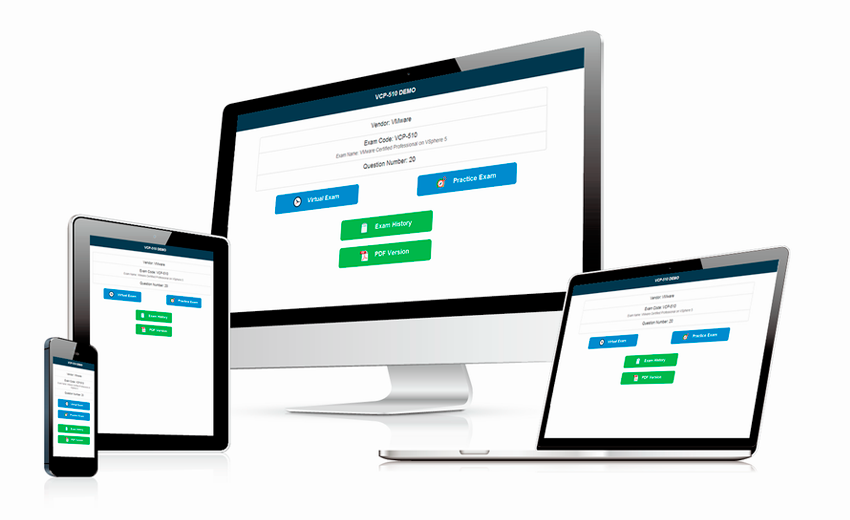
Try Before You Buy

Download a free sample of any of our exam questions and answers

  • 24/7 customer support, Secure shopping site
  • Free One year updates to match real exam scenarios
  • If you failed your exam after buying our products we will refund the full amount back to you.

VMware 2V0-642 Exam Braindumps - in .pdf Free Demo

  • Exam Code: 2V0-642
  • Exam Name: VMware Certified Professional 6 - Network Virtualization 6.2 Exam
  • , Last Updated: Aug 27, 2026
  • Q & A: 121 Questions and Answers
  • Convenient, easy to study. Printable VMware 2V0-642 PDF Format. It is an electronic file format regardless of the operating system platform. 100% Money Back Guarantee.
  • PDF Price: $59.99    

VMware 2V0-642 Exam Braindumps - Testing Engine PC Screenshot

  • Exam Code: 2V0-642
  • Exam Name: VMware Certified Professional 6 - Network Virtualization 6.2 Exam
  • , Last Updated: Aug 27, 2026
  • Q & A: 121 Questions and Answers
  • Uses the World Class 2V0-642 Testing Engine. Free updates for one year. Real 2V0-642 exam questions with answers. Install on multiple computers for self-paced, at-your-convenience training.
  • Testing Engine Price: $59.99    

VMware 2V0-642 Value Pack (Frequently Bought Together)

If you purchase VMware 2V0-642 Value Pack, you will also own the free online test engine.

PDF Version + PC Test Engine + Online Test Engine

Value Pack Total: $119.98  $79.99


About VMware 2V0-642 Exam Braindumps

VMware 2V0-642 Exam Certification Details:

Duration120 minutes
Exam NameVMware Certified Professional 6 - Network Virtualization (NSX v6.2) (VCP-NV 2020)
Number of Questions77
Passing Score300 / 500
Exam Price$250 USD
Schedule ExamPEARSON VUE
Sample QuestionsVMware 2V0-642 Sample Questions
Exam Code2V0-642
Recommended Training / BooksVMware NSX: Install, Configure, Manage [V6.2]
VMware NSX for Internetworking Experts Fast Track [V6.2]
VMware NSX: Design & Deploy [V6.2]

Reference: https://mylearn.vmware.com/mgrReg/plan.cfm?plan=95141&ui=www_cert

Absolutely based on real exam

Our company insists on communicating with our customers can make us improve the quality of our 2V0-642 exam preparatory. After the researches of many years, we found only the true subject of past-year exam was authoritative and had time-validity. So, according to the result of researches which made by our experts, we develop the new type of 2V0-642 practice test based on the true subject of past-year exam. At the same time, we will continually make amendment to the 2V0-642 study materials and make sure it is suitable to the latest exam. If you have any doubts about the quality of our 2V0-642 exam preparatory, we will provide free demo for your reference.

A new science and technology revolution and industry revolution are taking place in the world. Under this circumstance, many companies have the higher requirement and the demand for the abilities of workers. There is no doubt that passing the VMware 2V0-642 exam can make you stand out from the other competitors and navigate this complex world. A certification not only proves your ability but also can take you in the door for new life (with 2V0-642 study materials). So it has very important significances of getting your favorable job, promotion and even pay-raise. What our company specializing in 2V0-642 exam preparatory is helping our customer to pass exam easily. For that, we spent many years on researches of developing effective 2V0-642 practice test and made it become the best auxiliary tool for the preparation. These 2V0-642 study materials definitely are the best materials you have ever seen.

Free Download 2V0-642 Exam braindumps

Diverse version for choice

In view of the different requirements of our customers from all walks of life, we have developed three versions of 2V0-642 practice test (the PDF version, PC engine version and APP version) for you reference. Different versions have different advantages, but you can choose any combination of the different version. So it means that you can take more targeted approach to correct mistakes. The PC engine version of 2V0-642 study materials has the impeccable simulation system for your test. Lastly, the APP version of 2V0-642 exam preparatory can be installed on your smartphone. You just need download the content you wanted, and then you can learn it whenever, even you are on offline state.

High passing rate

According to the feedbacks from our former customers, the passing rate of our 2V0-642 practice test has reached up to 95% to 99%. In other words, a person who has used our products can almost pass the actual exam. We can avouch for the quality of our 2V0-642 study materials because we have ever mobilized a large number of experts to investigate the true subject of past-year exam. If you become the failure with our 2V0-642 exam preparatory unluckily, we will give you full refund with no reason or you can exchange another version of equivalent exam materials of great help. This kind of situation is rare, but we give you the promise as a protection for your benefits

After purchase, Instant Download: Upon successful payment, Our systems will automatically send the product you have purchased to your mailbox by email. (If not received within 12 hours, please contact us. Note: don't forget to check your spam.)

VMware VCP-NV 2020 Exam Syllabus Topics:

SectionObjectives

Section 1: Understand VMware NSX Technology and Architecture

Compare and Contrast the Benefits of a VMware NSX Implementation-Determine challenges with physical network implementations
-Understand common VMware NSX terms
-Differentiate NSX network and security functions and services
-Differentiate common use cases for VMware NSX
Understand VMware NSX Architecture-Differentiate component functionality of NSX stack infrastructure components
- Compare and contrast with advantages/disadvantages of topologies (star, ring, etc.) as well as scaling limitations
-Compare and contrast VMware NSX data center deployment models
-Prepare a vSphere implementation for NSX
Prepare a vSphere implementation for NSX- Differentiate logical and physical topologies, components and services
-Differentiate logical and physical security constructs
  • Endpoint Security
  • Data Security
  • Flow Monitoring
  • Activity Monitoring
  • Distributed Firewall
  • Perimeter Firewall
Understand VMware NSX Integration with Third-Party Products and Services-Understand integration with third-party partner tools and systems using NSX REST APIs
-Determine integration with third-party services
  • Network services
  • Security services
  • Load Balancing
  • Anti-malware
  • IDS/IPS

-Determine integration with third-party hardware

  • Network Interface Cards (NICs)
  • Terminating overlay networks
  • HW VTEP
  • VXLAN offload
  • RSS

-Install/register a third-party service with NSX

Understand VMware NSX Integration with vRealize Automation (vRA)-Understand integration with vRealize Automation
-Demonstrate NSX deployment capabilities built into vRealize Automation
-Compare and contrast Network Profiles available in vRealize Automation
-Understand NSX preparation tasks for attaching a network profile to a blueprint
- Discern vRealize Automation preparation tasks for deploying a machine with on-demand network services

Section 2: Understand VMware NSX Physical Infrastructure Requirements

Compare and Contrast the Benefits of Running VMware NSX on Physical Network Fabrics-Differentiate physical network topologies
  • Differentiate physical network trends
  • Understand the purpose of a Spine node
  • Understand the purpose of a Leaf node

-Differentiate virtual network topologies

  • Enterprise
  • Service Provider Multi-Tenant
  • Multi-Tenant Scalable

-Given a specific physical topology, determine what challenges could be addressed by aVMware NSX implementation.
- Differentiate physical/virtual QoS implementation
- Differentiatesingle/multiplevSphereDistributedSwitch(vDS)/DistributedLogical Router implementations
-Differentiate NSX Edge High Availability (HA)/Scale-out implementations
-Differentiate Separate/Collapsed vSphere Cluster topologies
- Differentiate Layer 3 and Converged cluster infrastructures

Determine Physical Infrastructure Requirements for a VMware NSX Implementation-Discern management and edge cluster requirementsDifferentiateminimum/optimalphysicalinfrastructurerequirementsfora VMwareNSX implementation
-Determine how traffic types are handled in a physical infrastructure
-Determine use cases for available virtual architectures
-Describe ESXi host vmnic requirements
-Differentiate virtual to physical switch connection methods
-Compare and contrast VMkernel networking scenarios

Section 3: Configure and Manage vSphere Networking

Configure and Manage vSphere Distributed Switches (vDS)-Compare and contrast vDS capabilities
-Create/Delete a vDS
-Add/Remove ESXi hosts from a vDS
-Edit general vSphere vDS settings
-Add/Configure/Remove dvPortgroups
- Configure dvPort settings
-Add/Remove uplink adapters to dvUplinkgroups
-Create/Configure/Remove virtual adapters
-Migrate virtual machines to/from a vDS
-Monitor dvPort state
-Determine use cases for a vDS
Configure and Manage vDS Policies-Compare and contrast common vDS policies
-Configure dvPortgroup blocking policies
-Explain benefits of Multi-Instance TCP/IP stack
-Configure load balancing and failover policies
-Configure VLAN settings
-Configure traffic shaping policies
-Enable TCP Segmentation Offload (TOE) support for a virtual machine
-Enable Jumbo Frame support on appropriate components
-Determine appropriate VLAN configuration for a vSphere implementation
-Understand how DSCP is handled in a VXLAN frame

Section 4: Install and Upgrade VMware NSX

Configure Environment for Network Virtualization- Comprehend physical infrastructure configuration for NSX Compute, Edge and Management clusters (MTU, Dynamic Routing for Edge, etc.)
-Prepare a Greenfield vSphere Infrastructure for NSX Deployment
  • Configure Quality of Service (QoS)
  • Configure Link Aggregation Control Protocol (LACP)

-Configure a Brownfield vSphere Infrastructure for NSX
-Determine how IP address assignments work in VMware NSX
- Determine minimum permissions required to perform an NSX deployment task in a vSphere implementation

Deploy VMware NSX Components-Install/Register NSX Manager
-Prepare ESXi hosts
-Deploy NSX Controllers
-Understand assignment of Segment ID Pool and appropriate need for Multicast addresses
-Install Guest Introspection
-Create an IP pool
-Understand when to use IP Pools versus DHCP for VTEP configuration
Upgrade Existing vCNS/NSX Implementation- Based on a given upgrade scenario, identify requisite steps and components for upgrading to NSX 6.x
-Upgrade vCNS 5.5 to NSX 6.x
-Upgrade vCNS Virtual Wires to NSX Logical Switches
-Upgrade to NSX Components
  • Upgrade to NSX Firewall
  • Upgrade to NSX Edge
  • Upgrade vShield Endpoint from 5.5 to 6.x
  • Upgrade to NSX Data Security

-Upgrade NSX Manager from 6.0 to 6.x
-Update vSphere Clusters after NSX upgrade
-Understand the impact of availability to the aspects of NSX during an upgrade

Expand Transport Zone to Include New Cluster(s)-Understand the function of a Transport Zone
-Understand proper addition of a Transport Zone
-Understand necessity to expand or contract a Transport Zone
-Edit a Transport Zone
-Understand appropriate use of Control Plane mode modification of a Transport zone

Section 5: Configure VMware NSX Virtual Networks

Create and Administer Logical Switches-Given a scenario, demonstrate the proper way to add/remove a Logical Switch
-Determine use case for and contrast the three Control Plane Modes
  • Multi-cast
  • Hybrid
  • Unicast
  • Determine use case for connecting a Logical Switch to an NSX Edge gateway

-Deploy services to a Logical Switch
-Demonstrate multiple ways of adding or removing virtual machines from a Logical Switch
-Test Logical Switch connectivity

Configure VXLAN-Determine areas where VXLANs should be configured
-Understand physical network requirements for virtual topologies with VXLANs
-Understand how to prepare a vSphere cluster for VXLAN
-Determine the appropriate teaming policy for a given implementation
-Understand how to configure and modify the options of a Transport Zone
-Understand how prepare VXLAN Tunnel End Points (VTEPs) on vSphere clusters
Configure and Manage Layer 2 Bridging-Given a scenario, determine an appropriate High Availability configuration for Layer 2 Bridging
-Understand how to add a Layer 2 Bridge to an NSX Edge device
-Determine when Layer 2 Bridging would be required for a given NSX implementation
-Determine use cases for multiple Layer 2 Bridges
-Compare and contrast software and hardware bridging
Configure and Manage Logical Routers-Install NSX Edge
-Understand how to connect/disconnect a Logical Switch from a logical router
-Understand and describe the different types of router interfaces
-Determine NSX components needed to build out topologies with logical routers
-Understand how to add and configure a new logical router
-Determine use case for and configure a management interface
-Determine use case for and configure High Availability for a logical router
-Configure routing protocols
  • Static
  • OSPF
  • BGP
  • IS-IS

-Configure default gateway
-Determine if cross-protocol route sharing is needed for a given NSX implementation
-Understand how to configure administrative distances for routing
-Understand configuration differences between iBGP and eBGP
-Understand and configure route redistribution

Section 6: Configure and Manage NSX Network Services

Configure and Manage Logical Load Balancing-Differentiate when to use the two topologies for load balancing
-Understand how to configure load balancing
-Configure and understand service monitors
-Understand how to Add/Edit/Delete a server pool
-Understand how to Add/Edit/Delete an application profile
-Understand how to Add/Edit/Delete virtual servers
-Determine appropriate NSX Edge instance size based on load balancing requirements
Configure and Manage Logical Virtual Private Networks (VPN)-Understand how to configure IPSec VPN
  • Configure IPSec VPN parameters
  • Enable logging

-Understand how to configure Layer 2 VPN

  • Add Layer 2 VPN Client/Server
  • View Layer 2 VPN Statistics

-Configure Network Access/Web Access SSL VPN-Plus

  • Edit Client Configurations
  • Edit General Settings
  • Edit Web Portal Designs
  • Add/Edit/Delete IP Pools
  • Add/Edit/Delete Private Networks
  • Add/Edit/Delete Installation Packages
  • Add/Edit/Delete Users
  • Add/Edit/Delete Login/Logoff script

-Determine appropriate VPN service type for a given NSX implementation

Configure and Manage DHCP/DNS/NAT-Understand proper use and addition of a DHCP IP Pool
-Enable a DHCP IP pool
-Determine use and proper implementation of DNS services
-Determine when and how to configure Source NAT
-Determine when and how to configure Destination NAT
-Given a scenario, compare and contrast proper DHCP uses
Configure and Manage Edge Services High Availability-Given a scenario, compare and contrast proper HA uses
-Determine service availability during an Edge High Availability failover
-Differentiate NSX Edge High Availability and vSphere High Availability
-Configure NSX Edge High Availability
  • Configure heartbeat settings
  • Configure management IP addresses

-Modify and existing Edge High Availability deployment
-Determine resource pool requirements for a given Edge High Availability configuration
-Configure Equal-Cost Multi-Path Routing (ECMP)

  • Determine ECMP timers
  • Understand process flows

- Combine ECMP with other stateful services

Section 7: Configure and Administer Netw Network Security

Configure and Administer Logical Firewall Services-Add/Edit/Delete an Edge Firewall rule
-Configure Source/Destination/Service/Action rule components
- Compare and contrast between Edge Rule Types (PreRules/Internal/User Rules/Default Rules)
-Change the order of an Edge User Firewall rule
-Demonstrate how to configure an Edge Firewall PreRule
-Understand the limitations of ECMP and Edge Firewall Policy
Configure Distributed Firewall Services-Understand VM IP Address learning for the purposes of DFW vCenter attribute learning
-Differentiate between Layer 2 and Layer 3 rules
-Differentiate between entity-based and identity-based rules
-Understand firewall rule entities
-Determine rule processing order
-Understand rule segregation
-Demonstrate steps to Add/Delete a Distributed Firewall rule
-Demonstrate configuration of Source/Destination/Service/Action rule components
-Change the order of a Distributed Firewall rule
-Add/Merge/Delete a Distributed Firewall rule section
-Determine publishing requirements for rules in a given NSX implementation
-Demonstrate Import/Export Distributed Firewall Configuration
-Load Distributed Firewall configuration
-Determine need for excluding virtual machines from distributed firewall protection
-Describe SpoofGuard Operation and Default Policy and Actions
-Describe SpoofGuard IP Address Learning
-Determine requirements for a Spoofguard Policy
-Demonstrate how to Create and Edit a SpoofGuard Policy
  • IP Local Addresses
  • Approve IP addresses
  • Edit/Clear IP addresses
Configure and Manage Service Composer-Understand assets that can be used with a Security Group
-Differentiate services contained in a Security Policy
-Compare and contrast common Service Composer use cases
-Differentiate third party integration and service redirection
-Differentiate Security Groups and Security Policies
-Demonstrate the ability to redirect specific flows (e.g. 80) to network introspection services
- Differentiate between vCenter attribute based Firewall rules (including IP Sets) vs Active Directory identity-based rule
-Create/Edit a Security Group in Service Composer
-Create/Edit/Delete a Security Policy in Service Composer
-Map a Security Policy to a Security Group
-Add/Edit/Delete a Security Tag
-Assign and view a Security Tag

Section 8: Deploy a Cross-vCenter NSX environment

Differentiate single and Cross-vCenter NSX deployments-Understand the benefits/use cases for Cross-vCenter NSX
-Contrast single and Cross-vCenter deployment models
-Determine the appropriate NSX topology for a given use case
-Understand options for ingress and egress traffic flows in a multi-site topology
-Describe and differentiate Universal components
  • Universal Firewall rules
  • Universal Network and Security objects
  • Universal Logical Switches
  • Universal Distributed Logical Routers
Determine Cross-vCenter Requirements and Configurations-Deploy a Cross-vCenter NSX environment
  • Create and configure the Primary NSX Manager
  • Create and configure the Secondary NSX Manager

-Migrate an NSX deployment to Cross-vCenter
-Create and configure Cross-vCenter components

  • Universal Segment ID Pool
  • Universal Transport Zone
  • Universal Logical Switch
  • Universal Distributed Logical Router

-Compare and contrast Local and Universal Firewall Rules

Section 9: Perform Operations Tasks in a VMware NSX Environment

Configure Roles, Permissions, and Scopes-Understand default roles
-Understand Single Sign-On (SSO) integration
-Configure SSO
-Assign a role to a vCenter Server user or group
-Compare and contrast the uses for the various NSX Security Roles
- Determine how roles can be applied to a subset of the vCenter infrastructure for multi Tenancy purposes
-Understand how to apply NSX Roles to an AD group
-Assign objects to a user
-Enable/Disable a user account
-Edit/Delete a user account
Understand NSX Automation-Discern common use cases that require the NSX REST API
- Compare and contrast how the NSX REST API works and how it is used with a support browser
-Understand how NSX REST API Calls are sent to the NSX Manager
-Differentiate common NSX REST API verbs
-Determine how to use NSX REST API calls to learn the network topology
Monitor a VMware NSX Implementation-Compare and contrast available monitoring methods (UI, CLI, API, etc.)
-Monitor infrastructure components
  • Control Cluster Health
  • Manager Health
  • Hypervisor Health

-Perform Inbound/Outbound activity monitoring
-Enable data collection for single/multiple virtual machines
-Perform virtual machine activity monitoring
-Monitor activity between inventory containers (security groups, AD groups)
-Analyze network and security metrics in vRealize Operations
-Monitor logical networks and services

  • Identify available statistics/counters
  • Network/service health
  • Configure and collect data from network
Perform Auditing and Compliance-Given an auditing scenario, determine where applicable log information can be located
-Differentiate permissions for auditing
-Differentiate common data security regulations supported by NSX Data Security
-Differentiate information available in audit logs
-Use flow monitoring to audit firewall rules
-Audit deleted users
-Audit infrastructure changes
-View NSX Manager audit logs and change data
-Configure NSX Data Security
-Create a Data Security Policy
-Install Data Security
-Run a Data Security scan
-View and download compliance reports
-Create a regular expression
-Configure Guest Introspection (Install vShield Endpoint)
Administer Logging- Given a scenario, utilize information contained in technical support bundles/logs to assist in troubleshooting
-Explain usage of CLI for logging
-Configure Syslog(s)
-Configure logging for Dynamic Routing information
-Log Distributed Firewall rule processing information
-Log Edge Firewall rule processing information
-Log address translation information
-Log VPN traffic
-Configure basic/advanced Load Balancer logging
-Log DHCP assignments
-Log DNS resolutions
-Log security policy session information
-Download NSX Edge tech support logs
-Generate NSX Manager tech support logs
Backup and Recover Configurations-Understand how to backup and recover various components
-Schedule backups
-Export/Restore vSphere Distributed Switch configuration
-Import/Export Service Composer profiles
-Perform NSX Manager backup and restore operation

Section 10: Troubleshoot a VMware Network Virtualization Implementation

Compare and Contrast Tools Available for Troubleshooting-Capture and trace uplink, vmknic, and physical NIC packets
-Audit NSX infrastructure changes
-Output packet data for use by a protocol analyzer
-Capture and analyze traffic flows
-Mirror network traffic for analysis
-Perform a network health check
-Configure vSphere Distributed Switch alarms
Troubleshoot Common NSX Installation/Configuration Issues-Troubleshoot lookup service configuration
-Troubleshoot vCenter Server link
-Troubleshoot licensing issues
-Troubleshoot permissions issues
-Troubleshoot host preparation issues
-Troubleshoot IP pool issues
Troubleshoot Common NSX Component Issues-Differentiate NSX Edge logging and troubleshooting commands
-Verify NSX Controller cluster status and roles
-Verify NSX Controller node connectivity
-Check NSX Controller API service
-Validate VXLAN and Logical Router mapping tables
-List Logical Router instances and statistics
-Verify Logical Router interface and route mapping tables
-Verify active controller connections
-View Bridge instances and learned MAC addresses
-Display Logical Router instances
-Verify NSX Manager services status
-View Logical Interfaces and routing tables
-Analyze NSX Edge statistics
Troubleshoot Common Connectivity Issues-Review netcpa logs for control plane connectivity issues
-Verify VXLAN, VTEP, MAC, and ARP mapping tables
-List VNI configuration
-View VXLAN connection tables and statistics
-Perform VTEP connectivity tests
Troubleshoot Common vSphere Networking Issues-Verify network configuration
-Verify a given virtual machine is configured with the correct network resources
-Troubleshoot virtual switch and port group configuration issues
-Troubleshoot physical network adapter configuration issues
-Determine the root cause of a network issue based on troubleshooting information

What Clients Say About Us

Passed with laurels! Braindumps 2V0-642 Study Guide provides information in a select number of QandA that covers all key issues. It saved me going through lengthy study sources and provided me what I actually needed.

Selena Selena       4 star  

Plug and Play
I used to prefer proper training and learning through whole syllabus before any certification exam, but this time on the suggestion of one of my office colleagues I tried ExamsTorrent .

Hubery Hubery       5 star  

The 2V0-642 exam questions are so efficient that no other guide provides such accuracy. I passed with 99% scores. Great!

Salome Salome       4 star  

The 2V0-642 training dump is a good study guide for the 2V0-642 exam. I studied the dump over and over, as they predicted that i passed the 2V0-642 exam. Thanks to all of you!

Reuben Reuben       4.5 star  

I passed the 2V0-642 exam in my first attempt by using 2V0-642 exam braindumps, and I will buy preparation materials from ExamsTorrent for my next exam.

Chasel Chasel       4 star  

Exam practise engine given by ExamsTorrent gives a thorough understanding of the 2V0-642 certification exam. Helped me a lot to pass the exam. Highly recommended.

Hardy Hardy       5 star  

I passed my 2V0-642 exam yesterday. Almost all the questions were similar to the practice exam. Thank you so much ExamsTorrent for these updated dumps.

Cornelia Cornelia       5 star  

The 2V0-642 practice test questions are extremely good for the students. They can simulate and predict the real exam. And they are accurate. Thanks! We all passed our 2V0-642 exam by studying them.

Maud Maud       5 star  

The answers of the 2V0-642 dumps are accurate and correct! I passed the exam with these 2V0-642 Software questions. Thank you! So happy now!

Heather Heather       4 star  

It is really a good 2V0-642 guide I think, and thank you very much.

Pag Pag       5 star  

ExamsTorrent is a nice platform to enhance knowledge and expertise in the technical field, the most important is to help get the 2V0-642 certification. I have received mine. Wish you good luck!

Greg Greg       4.5 star  

The questions from your dumps were very helpful and 95% exams were covered. Thanks.

Morton Morton       4 star  

You are obviously put a lot of time into it.
Thank you, I passed 2V0-642

Mildred Mildred       4.5 star  

I really like online version,i can practice my dumps anywhere with it and finally i passed 2V0-642.... so much appreciate

Violet Violet       4 star  

LEAVE A REPLY

Your email address will not be published. Required fields are marked *

Quality and Value

ExamsTorrent Practice Exams are written to the highest standards of technical accuracy, using only certified subject matter experts and published authors for development - no all vce.

Tested and Approved

We are committed to the process of vendor and third party approvals. We believe professionals and executives alike deserve the confidence of quality coverage these authorizations provide.

Easy to Pass

If you prepare for the exams using our ExamsTorrent testing engine, It is easy to succeed for all certifications in the first attempt. You don't have to deal with all dumps or any free torrent / rapidshare all stuff.

Try Before Buy

ExamsTorrent offers free demo of each product. You can check out the interface, question quality and usability of our practice exams before you decide to buy.